 Korean
 English
 German
 French
 Russian
 Spanish
Why do two factories quote the same 25 cm plush at $3.20 and $5.60 per unit? Not profit margin — specification. A plush toy cost breakdown is a stack of physical inputs, and the three biggest levers are exactly the ones buyers spec least carefully: fabric yield (how efficiently your pattern pieces nest on the roll), seam complexity (how many panels an operator must sew), and stuffing density (grams of fill per unit, weighed or eyeballed). Buyers who understand these three drivers stop comparing quotes blind and start negotiating line items — and the difference compounds brutally at volume: over a 10,000-unit order, unspecified defaults can swing total cost by $20,000–$80,000.
에서 StuffPlush, we cost every custom plush program line by line, and we give buyers the same input grid our costing team uses. This guide opens up the three dominant cost drivers — with the yield math, piece counts, and fill weights that move your quote — so the next quotation on your desk becomes a conversation about specifications instead of a guessing game about padding. If you have not yet locked your fabric grade, read our velboa vs minky spec comparison first, and if your timeline is tight, bookmark our CNY 2027 sourcing countdown — cost drivers and calendar deadlines interact more than most buyers expect.
First, the Cost Stack: Where the Money Actually Sits
Before the three drivers, the full picture. A typical 12-inch plush at 1,000-unit MOQ breaks down roughly as:
| Cost Component | Share of Unit Cost | Buyer Controllable? |
|---|---|---|
| Shell fabric | 15–25% | ✅ High — grade, GSM, yield |
| 스터핑 | 3–8% | ✅ High — weight, fiber grade |
| Accessories & trims | 5–15% | ✅ Medium — eyes, embroidery, tags |
| Direct labor | 25–35% | ✅ Medium — piece count, operations |
| 패키징 | 7–12% | ✅ Medium — box vs polybag, compression |
| Energy & overhead | 5–10% | ❌ Absorbed by factory |
| Factory margin | 8–15% | ⚠️ Negotiable, but not the gap |
The strategic insight: direct costs (fabric, fill, labor — roughly 65–75% combined) are spec-driven, which means the buyer controls them through the tech pack, not through haggling. Two quotes 30% apart are almost never separated by margin — they are separated by fabric grade, fill density, or panel count.
Driver 1: Fabric Yield — The Hidden Variable in Every Quote
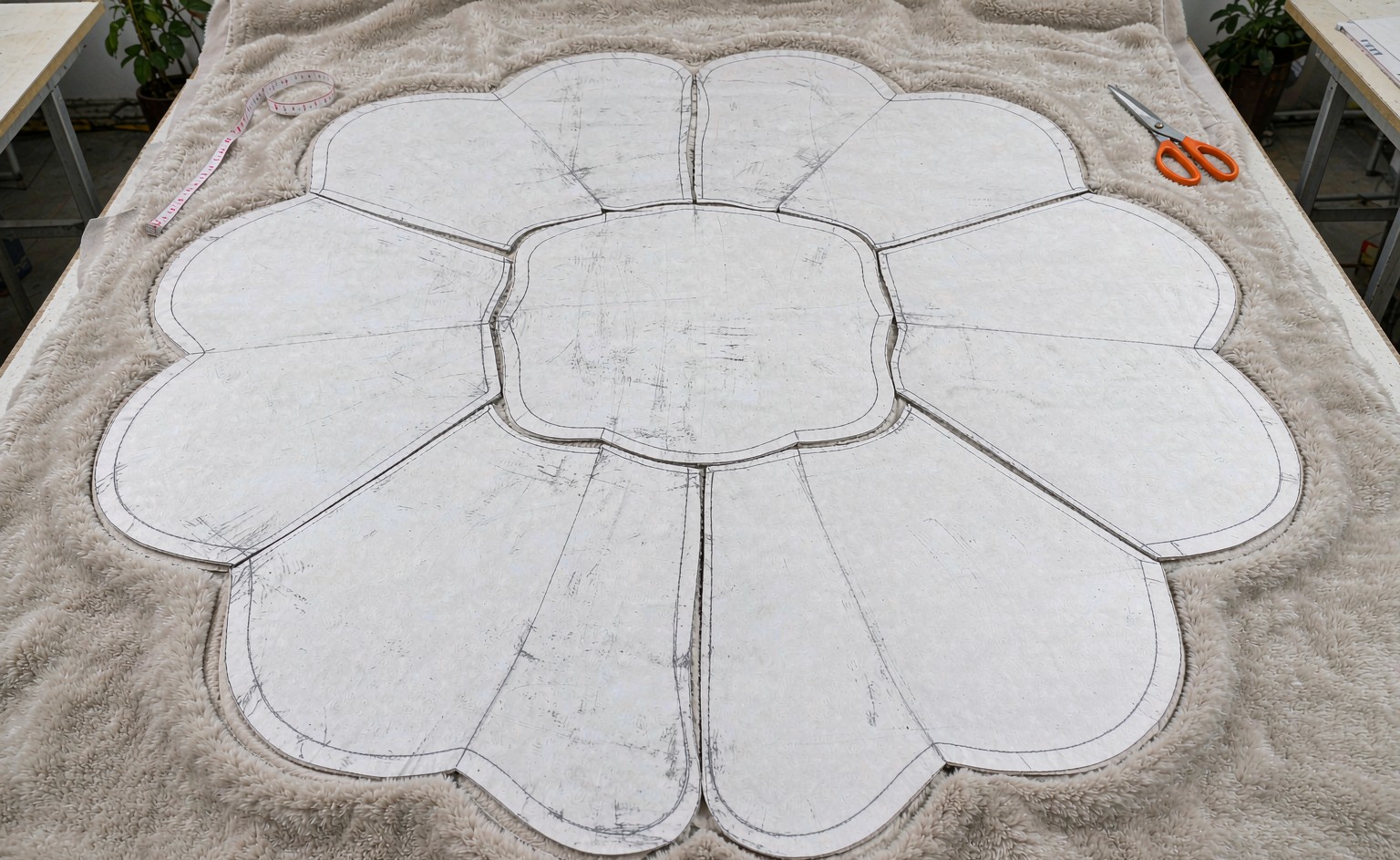
Fabric is usually the largest single line item, and its real cost driver is not the per-meter price — it is how much of each meter ends up in toys.
The Yield Math
Fabric yield = the percentage of a fabric roll that becomes usable pattern pieces. Three factors determine it:
- Pattern nesting efficiency: irregular curved pieces (heads, ears, tails) waste more fabric than rectangular ones. A blocky character can hit 80–85% yield; a complex animal with curved limbs may drop to 65–70%.
- Nap and grain direction: directional fabrics (minky, long-pile) force all pieces onto the same orientation, killing mixed-orientation nesting and costing 8–15% extra yield versus non-directional velboa.
- Color and dye-lot strategy: custom Pantone colors on small orders carry dye surcharges and minimum dye-lot sizes; stock colors cut both cost and lead time.
What Yield Means in Dollars
For a 25 cm bear consuming roughly 0.4–0.6 yards of fabric:
| 패브릭 | Per-Unit Fabric Cost | Yield Sensitivity |
|---|---|---|
| Velboa (220–280 GSM, non-directional) | $1.20–2.40 | Low — nesting flexibility high |
| Minky (260–360 GSM, directional) | $2.40–7.20 | Medium — nap alignment penalty |
| Premium long-pile faux fur | $7.20–15.00 | High — directional + grooming waste |
Buyer action: ask every quoting factory to state their assumed fabric utilization percentage. A factory quoting 82% yield against one quoting 68% is not lying — one has better CAD nesting (modern Optitex-style nesting) and older, looser manual markers. The 14-point yield gap can be worth 10–15% of your unit cost.
Driver 2: Seam Complexity — Where Labor Cost Hides
Labor is 25–35% of unit cost, and its driver is not toy size — it is piece count and operations.
The Piece-Count Ladder
| Design Type | Typical Panel Count | Sewing Labor Impact |
|---|---|---|
| Simple blob character / pillow plush | 6–10 pieces | Baseline |
| Standard animal (head gusset, 4 limbs) | 14–20 pieces | +40–60% sewing time |
| Complex licensed-style character (paw pads, muzzle, inner ears, tail) | 30–45 pieces | +100–150% sewing time |
Every extra panel is another seam, another handling step, and another chance for a defect — which is why complex designs also carry higher quality control costs, not just labor costs.
The Four Hidden Labor Multipliers
Beyond piece count, four spec decisions multiply labor invisibly:
- Curved vs straight seams: curved stitching runs at half the speed of straight runs. A design full of S-curves sews 2× slower than its panel count suggests.
- Embroidery stitch count: billed per 1,000 stitches; a dense satin-stitch face can add $0.80–2.50 per unit at production volumes — and dense embroidery is also a quality control checkpoint, since puckering or thread breaks on the face are visible defects.
- Hand-finishing operations: ladder-stitch closing, seam grooming (brushing trapped fur), and accessory hand-sewing are pure manual minutes — a fur-grooming step on long-pile designs adds real cost that never appears as a line item.
- Turning and stuffing access: pieces too narrow to turn right-side-out slow the line dramatically — one more reason the pattern-making stage decides cost before sewing ever starts.
Buyer action: ask for the panel count and the estimated sewing minutes per unit. Any factory that costed your design properly knows both numbers; a factory that cannot answer has not actually engineered your design — it has guessed.
Driver 3: Stuffing Density — The Cheapest Spec to Get Wrong
Stuffing is only 3–8% of unit cost, but it is the most frequently gamed line item in the industry — because it is nearly invisible until the toy slumps.
The Weight Discipline
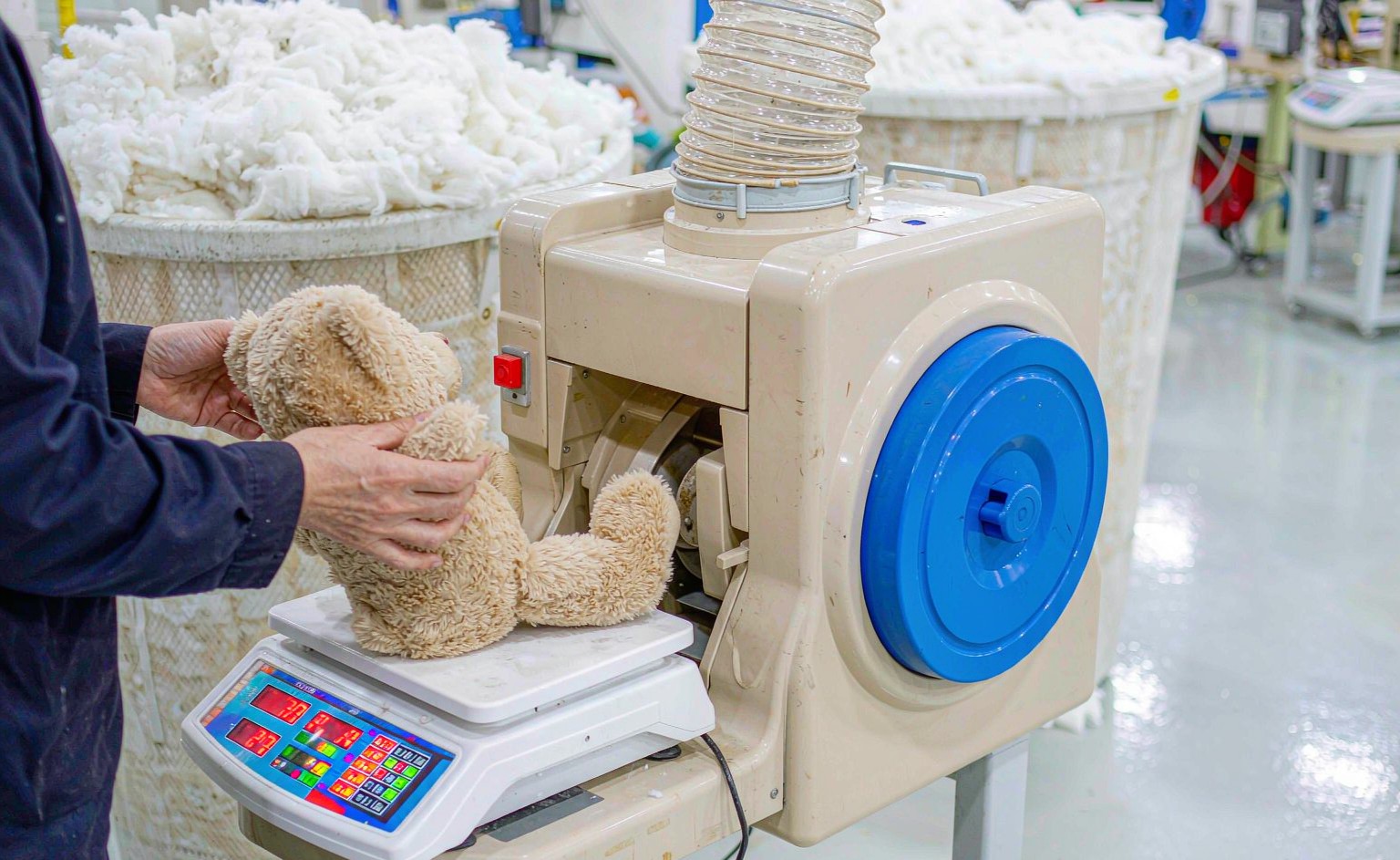
A 25 cm plush uses 180–220 g of polyester fiberfill at roughly $1.50–1.70/kg (hollow-conjugate grade). The per-unit cost difference between 180 g and 220 g is about $0.06 — trivial per unit, and precisely why understuffing is the industry’s favorite silent margin: across 10,000 units, shaving 30 g per toy saves ~$500 while visibly degrading every toy on the shelf.
The Grade Question: Virgin vs Recycled Fiber
| Fill Grade | Cost/kg | Behavior | Spec Guidance |
|---|---|---|---|
| Virgin 7D/15D hollow-conjugate siliconized | $1.50–1.70 | Superior loft, recovery after vacuum packing | Standard for retail plush |
| Ungraded recycled fiberfill | 25–35% cheaper | Clumps, coarser hand | Promo-tier only |
| GRS-certified recycled fill | +10–25% premium | Near-virgin performance with chain-of-custody | Eco programs (spec certified source in the materials guide) |
Buyer action: put fill weight in grams (±5g) and fiber grade into the PO, and require a weighed-per-unit discipline on the line — the stuffed-room scale is the most honest QC instrument in a plush factory. Then verify at inspection: weigh 10 random units against spec. A factory that stuffed to feel instead of weight will fail this check within minutes.
How the Three Drivers Interact (and Where Buyers Overcorrect)
The drivers are not independent — optimizing one in isolation degrades another:
- Aggressive yield optimization (tighter nesting, fewer panels) reduces fabric waste but can force awkward seam geometry, raising labor and defect rates.
- Panel-count reduction cuts labor but flattens the silhouette, hurting shelf appeal — the cheapest-to-make toy is often the hardest to sell.
- Over-stuffing compensates for thin fabric (sub-220 GSM velboa shows backing when stuffed firmly) but stresses seams — the failure mode our ASTM F963 tension testing guide measures directly.
The professional approach is a balanced spec: target yield 75–80% for typical designs, panel count appropriate to the silhouette (not minimum, not maximum), and fill weight matched to fabric grade — all three frozen in the tech pack before quotation.
A Worked Example: Same Design, Three Spec Levels
To make the drivers concrete, here is one 25 cm sitting bear costed three ways (3,000-unit scale, FOB China, indicative 2026 pricing):
| Spec Element | Budget Spec | Balanced Spec | Premium Spec |
|---|---|---|---|
| 패브릭 | Velboa 220 GSM, stock color | Minky 300 GSM + velboa face, custom color | Minky 360 GSM + long-pile accents |
| Panels | 12 pieces | 18 pieces | 28 pieces + accessories |
| Fill | Recycled fiberfill, 170 g | Virgin 7D, 200 g | Virgin 7D, 220 g + weighted pellet base |
| 자수 | Minimal, 800 stitches | Standard face, 2,000 stitches | Dense face + logo, 4,500 stitches |
| FOB per unit | $2.10 | $3.40 | $5.90 |
| Retail tier support | $7.99–9.99 | $14.99–24.99 | $29.99+ |
Same drawing. A 2.8× cost range — driven entirely by the three levers this guide covers. This is why “compare three quotes” only works when all three factories are quoting the same specification; otherwise you are comparing three different products that happen to share a sketch.
How StuffPlush Quotes: Line-Item Transparency
에서 StuffPlush, every quotation itemizes the cost stack: fabric grade with GSM and yield assumption, panel count, fill weight and fiber grade, stitch counts, packaging spec, and the margin line — so when you want to tune cost, we tune specifications together rather than arguing percentages. Our production team will also model your design at two or three spec tiers side by side, so you can see exactly what each retail price point requires before committing.
자주 묻는 질문
What percentage of plush toy cost is fabric?
Shell fabric typically runs 15–25% of unit cost at production volumes, with stuffing adding another 3–8% — so materials combined are roughly 30–40% of the stack. But fabric is the largest single line and the one with the widest legitimate range: velboa at $1.20–2.40 per unit versus premium faux fur at $7.20–15.00 for the same size toy. Combined with labor (25–35%), the spec-controlled portion of your quote is 65–75% — which is why specification discipline beats negotiation for cost reduction.
How do factories reduce plush toy cost without cutting quality?
The honest levers, in order of impact: (1) improve pattern nesting — modern CAD nesting recovers 5–10% fabric yield with zero quality cost; (2) rationalize panel count — removing pieces that add no silhouette value; (3) use stock colors instead of custom dye lots on smaller orders; (4) consolidate accessories — one branded hangtag instead of three trims; (5) optimize carton packing — vacuum compression can cut shipping volume up to 60% on suitable designs. The dishonest levers — thinner fabric, lighter fill, skipped testing — show up as returns and reviews within one season.
Why do quotes for the same design vary so much between factories?
Because a sketch is not a specification. The same 25 cm bear drawing can be costed with 12 or 28 panels, 220 or 360 GSM fabric, 170 or 220 g of fill, and screen-printed or embroidered features — a spread from roughly $2 to $6 per unit before anyone discusses margin. Wide quote gaps almost always reflect unstated spec differences, not profit differences. The fix: freeze the tech pack (fabric GSM, fill weight, stitch counts, panel count) and require all bidders to quote against the identical document.
How much stuffing should a plush toy have?
A typical 25 cm plush uses 180–220 g of polyester fiberfill; smaller keychain plush 15–30 g; larger 40 cm+ plush 300–450 g. The right number depends on fabric grade and desired firmness — thin sub-220 GSM fabrics show backing when stuffed firmly, while heavier fabrics support denser fills. The critical practice is not the exact number but the discipline: fill weight written into the PO (±5 g) and verified by weighing random units at inspection, because stuffing-to-feel drifts lighter as production runs continue.
Do bigger orders really get meaningfully lower prices?
Yes, but with a step structure rather than a smooth curve. At 500 units you get stock-color fabric and standard construction; at 2,000 units custom Pantone dyeing unlocks; at 10,000+ units custom tooling and priority scheduling follow. Note the volume nuance: 2,000 units of one SKU usually prices below 500 units of four colorways, because each color change is a separate dye and setup event. Structure your order around volume tier thresholds rather than spreading thin across variants.
Conclusion: Stop Comparing Quotes, Start Comparing Specifications
Every durable margin in plush sourcing comes from the same move: converting a vague design into a specified product — fabric grade with GSM, panel count with yield assumption, fill weight with fiber grade — and then letting factories compete on execution rather than interpretation. The three drivers in this guide are where 65–75% of your unit cost lives, and all three are controllable from your desk, months before production starts.
에서 StuffPlush, we quote 맞춤형 플러시 programs line by line — and we will happily model your design at budget, balanced, and premium spec tiers so you can see exactly which levers move your price. If you are preparing an RFQ, start with our buyer’s guide, verify your fabric choices against our material spec comparison및 문의하기 for a line-item quotation — the kind where every number has a reason attached.